


Testimonials

Not being a cricket fan, I was, however, impressed by the number of big blokes, who embraced the McGrath Foundation cause, and turned out in pink for the 3 Mobile Sydney Test in January.

That night, Channel 9 replayed an interview with Jane, where she mentioned something about having a niggly feeling in her breast, which prompted her to have a breast check. Her words resonated with me, as I realised that I had recently also had and niggly feeling in my left breast.

That evening, I did a self check, and found a lump in the left breast, which turned out to be cancer. I will be eternally grateful for the pink cricket test, as I really don't think I would have gotten myself checked if I hadn't been prompted on that day. I'm even considering becoming a cricket fan!
Kerry Seeto

I feel as if I owe my life to Tracy, Jane and the McGrath Foundation.

A few months ago Tracy came to my firm as part of a charity event to raise funds for the McGrath Foundation. She relayed Jane’s story to us. Tracy’s talk left such an impression on me. I was touched by Jane’s story and Tracy and Jane’s beautiful friendship. I walked away from that event with the message of how important self examination is and that you should act if you notice any change – anything that is different for you – no matter how inconsequential you think it might be.

Shortly afterwards I discovered something in my left breast that did not feel right. I have very lumpy breasts so to feel a lump was nothing new to me. I probably would have put off doing anything about it as I was in no pain. However, Tracy’s words kept coming to me. I made an appointment at the breast clinic. Lucky for me I did. I discovered my lump was a malignant tumour and that the cancer had spread to the lymph nodes. I am currently undergoing chemotherapy. I will then have surgery followed by a course of radiotherapy but am expected to make a full recovery.

Had it not been for Tracy, Jane and the Foundation, I don’t know what would have happened to me.

Annette Fong

Breast Aware

Jane McGrath - Founder, McGrath Foundation

After my diagnosis with breast cancer at 31, I can tell you firsthand that breast cancer doesn’t just happen to older women – it can happen to anyone, even young women.

My message to you is to become 'Breast Aware' by regularly checking your breasts for any changes or lumps. The sooner you find a change and go to see your GP, the better.

Please download this information as a gift from the McGrath Foundation and keep it as a guide on how you can become 'Breast Aware'. It could save your life.


Jane McGrath
Founder
McGrath Foundation
1966-2008


Being Breast Aware

Because breast cancer affects women of all ages, it is important that all women, including young women, examine their breasts regularly to pick up any changes. Self-examination is important because if you’re aware of how your breasts normally look and feel, you’re more likely to notice a change if it develops.

In addition to seeing your doctor each year for a breast examination, you should check your breasts regularly. A good time to do this is after the last day of your menstrual cycle or if you do not have periods, the same date each month. Most women find that their breasts are easier to examine just after their period when any premenstrual pain and lumpiness have settled.

You may check your breasts standing up, for example in the shower, or lying down, for example before going to sleep. Your partner should also be alert and look for changes in your breasts.


You can check your breasts by:

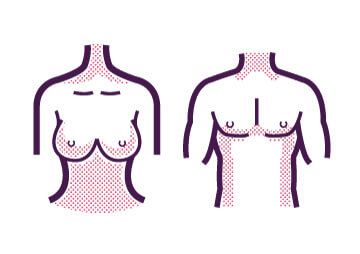
  • Looking at the shape and appearance of your breasts and nipples in the mirror with your hands by your sides
  • Raising your arms above your head and looking for a change in the shape of the breasts
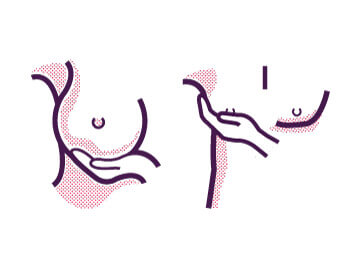
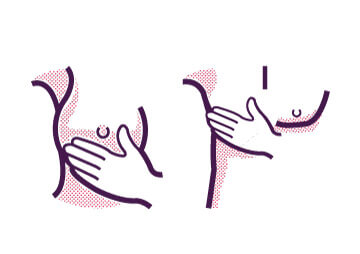
  • Feeling for lumps in the breasts either while lying down or standing
  • Feeling for lumps in the nipples area and in the armpits

You should look out for the following changes:

  • A lump or lumpiness or even a change in shape or appearance of your breast such a dimpling, redness and appearance of veins
  • An area that feels different to the rest of your breast or any pain in your breast
  • Any change in the shape or appearance of your nipple, such as your nipple being pulled in or development of a rash
  • A discharge from your nipple, particularly if it is bloody

If you find a change don't panic

Most changes in the breast are not related to breast cancer. However, if you do find a change in your breast or a lump, it is important to visit your GP immediately.


Remember, the sooner you see your GP after finding a change in your breast, the better

Your GP will conduct a clinical breast examination to determine whether you will need further testing.


Take control of your health – you can help protect yourself against breast cancer

Unfortunately, many of us will know someone who has been touched by breast cancer, which affects one in eight Australian women1 – but you can help protect yourself against the disease.

More women are surviving breast cancer than ever before due to better testing and treatment. Breast cancer survival is now up to 85 percent1. The smaller a breast cancer is, the simpler the treatment and the better the outcome.


Early detection has been proven to save lives.
Be 'Breast Aware' and check your breasts regularly.

To download and print the breast awareness card click here.

This file is in PDF format, to view it you will need
Adobe Acrobat Reader that can be downloaded from here.

Click here to listen to Jane and Tracy's breast awareness message which airs on the  Austereo network nationally on Breast Check Day, the first day of every month.

References: 1 AIHW (Australian Institute of Health and Welfare) & AACR (Australasian Association of Cancer Registries) 2008. Cancer in Australia: an overview, 2008. Cancer series no. 46. Cat. no. CAN 42. Canberra: AIHW.